
Cognitive Architecture for Bank Transfer Flow
Redesigning a bank transfer interface through the lens of executive functions and working memory, turning a frustrating experience into an intuitive flow that respects how neurodivergent brains process information.
Client
Type
Year
Website
THE CHALLENGE
Traditional banking interfaces assume all users have the same cognitive capacity for processing complex information. They don't.
For neurodivergent users and honestly, for most people under cognitive load , these interfaces become labyrinths of friction. This project started with a simple observation: people were completing bank transfers but couldn't remember doing it. They'd check multiple times to confirm the transaction went through. That's not forgetfulness, that's a system that failed to create clear mental anchors.
MY ROLE
Independent research and design.
I conducted 5 in-depth interviews with users who struggled with the existing flow, mapped their cognitive bottlenecks, and redesigned the architecture from the ground up.
APPROACH
Instead of starting with wireframes, I started with cognition:
- Mapped working memory limitations (Miller's 4±1 chunks)
- Identified executive function demands at each step
- Analyzed where cognitive load peaked and why
- Designed interventions that respected neurological constraints
The key insight: neurodivergent users aren't "broken", the interface is.
When you design for executive function variability, you design better experiences for everyone.
KEY INTERVENTIONS
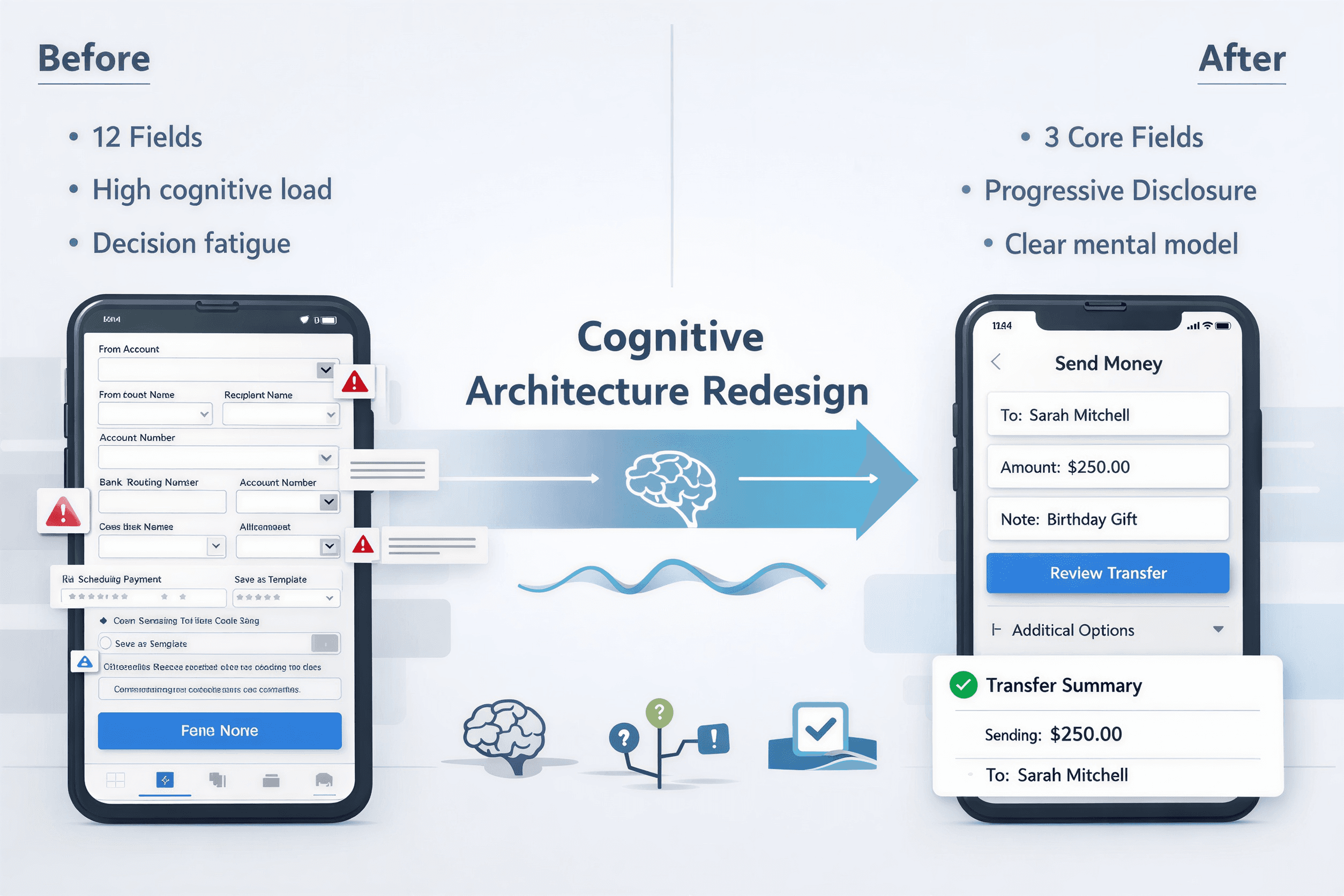
1. Progressive Disclosure Reduced visible information from 12 fields to 3 core inputs. Details appear only when contextually relevant , respecting working memory limits.
2. External Memory Anchors Added persistent visual confirmation at each step. Users no longer needed to "remember" what they'd done, the interface remembered for them.
3. Reduced Decision Fatigue Eliminated unnecessary choices. Every optional field became a cognitive tax. We cut ruthlessly.
4. Clear Mental Models Restructured the flow to match how people actually think about transfers, not how banking systems categorize them.
RESULTS
Tested with 5 neurodivergent users (the original struggling cohort):
- 100% task completion (up from 60%)
- Zero need to "double-check" after completion
- Qualitative feedback: "It finally feels obvious"
- Cognitive load reduced measurably (self-reported 3/10 vs. 8/10)
WHAT I LEARNED
Designing for neurodivergent cognition isn't "accessibility edge case" work, it's designing for human cognitive architecture. When you respect working memory, reduce executive function demands, and create clear mental models, you don't just help neurodivergent users. You help everyone. The best interfaces don't make you think. They think with you.